
A Godot open-world template: a seeded world of terrain and roads, with a car
By Eduardo Orellana · Updated
Flockbay ships an Open-World Driving template, free under New from template: a seeded procedural world of terrain and roads, movement on foot and a physics car you can get into. It is the ground floor of an open world, not the game on top of it. Flockbay is free, AI included: free hosted AI every day, or your own Claude, ChatGPT, agent or API key. It runs on Windows, macOS and Linux, on the official Godot engine.
AppImage, x86_64. Ubuntu 22.04, Debian 12, Fedora 39 or newer.
Intel or AMD Chromebook, with Linux turned on.
The Open-World Driving template in Flockbay
A seeded procedural world of terrain and roads to explore on foot, with a physics car you can get into. It is a 3D Godot 4 project in GDScript, open source under the MIT licence, and free like the rest of Flockbay.
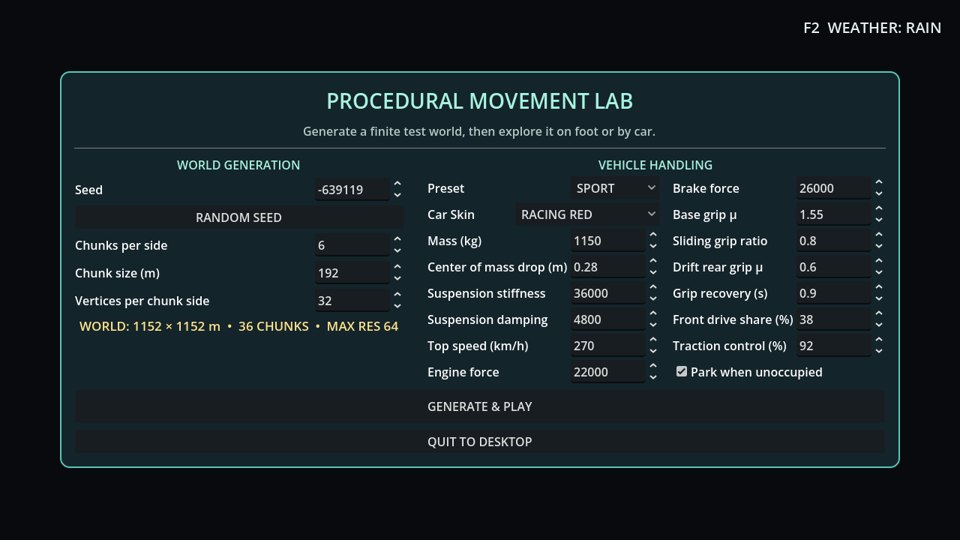
Seeded terrain in chunks, about 1.2 km across by default and up to 2.5 km, regenerated from a settings panel.
A road across the terrain with branches, four districts, enterable house shells and parkour spots.
First- and third-person movement with sprint, jump and mantle, and a four-wheel physics car with editable handling.
Weather that cycles through clear, overcast, rain and fog, desktop controls and a touch layout for Android.
More on this: Racing games are won or lost on the car, not the track
Start a game from Open-World Driving
In the Flockbay app, press New from template on Home, pick Open-World Driving and press Create. On a first run, answer 3D and then Template, and Continue makes the game. Flockbay downloads the template into a new game folder and opens it in the Godot editor as an ordinary Godot 4 project you own. Tell Flockbay what to change first: it writes a short brief from the template, asks before it builds, and plays each change before you do.
What people usually ask for first: delivery missions between districts; traffic that follows the roads; a day and night cycle with headlights.
What an open-world template can give you, and what it cannot
The expensive part of an open world is the space itself: terrain that renders and collides in chunks, roads that follow the ground, and a way to move across it that feels good on foot and in a vehicle. That is what this template is, and it is the part most people underestimate when they start.
What it leaves out on purpose is everything that makes the space a game: missions, traffic, persistence between sessions, combat, interiors worth entering and a reason to drive from one district to the next. The world is finite and regenerated from a seed, so a map you design by hand is a change to the generator or a switch to authored terrain.
Decide early whether your world is generated or authored. A seeded world is cheap to vary and hard to art-direct; an authored one is the opposite. Most open-world games that feel handmade are authored, with generation used for the filler.
More on this: Generating a track is the easy half of a racing game
Scope is the whole problem in this genre
An open world multiplies every other system by its size. A delivery mission is a timer and two points; a hundred of them across four districts is a content pipeline. Start with one loop you can play end to end in a small part of the map, then widen it.
Performance follows the same rule. The template builds its chunks off the main thread and keeps materials simple, which is why it runs; every prop, light and AI driver you add has a cost per chunk. Profile with the Godot debugger as you go rather than at the end.
A starting project for this is the adventure game templates. The design note that goes with it is how Zelda’s open world stays readable.
Questions
- Is the Open-World Driving template free to use in a commercial game?
- Yes. It is open source under the MIT licence, and the project carries its LICENSE file. Your changes and your game are yours.
- Does it run on mobile?
- It includes a multi-touch Android layout: a virtual stick and look drag on foot, and separate gas and brake buttons in the car. Export to Android goes through Godot's own Android export.
- Can I replace the procedural world with a map I design?
- Yes, but it is a real change rather than a setting: the generator places the roads, districts and houses, so an authored map means replacing that step. Flockbay's world tools can sculpt and paint terrain by hand if you go that way.