Image to game: what a picture can and cannot tell a tool
By Eduardo Orellana · Updated
Flockbay is free on your own Claude or ChatGPT plan. Claude Pro or Max, or ChatGPT Plus or higher, builds a real Godot project in the Godot editor. Claude Free and ChatGPT Free do not run here. More models are optional, a credit reload at API prices. Windows today. The engine is the official Godot release. A picture is an excellent brief for how something should look and a useless one for how it should play. Knowing which half you are holding is the whole trick.
What an image actually contains
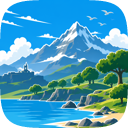
A reference image carries an enormous amount about look and mood. Palette, light, density, how much sky there is, whether the world feels overgrown or scraped clean, what time of day it is emotionally as well as literally. That is real information and it is hard to write down in words, which is exactly why people reach for pictures.
What it contains almost none of is game. It does not say what the player does, how fast they move, what happens when they get to the far side, or why they would care. Two games that look identical in a screenshot can be completely different to play, and the screenshot cannot tell you which one it is.
So a tool that promises to turn a picture into a game is promising something the picture does not contain. What it will actually do is pick a genre for you and dress it in your colours, and you will feel the mismatch immediately.
Using an image the way it is useful
Use it as a target for the world you are building. Flockbay has you build by hand, and what that means follows from the first thing a new project asks: 2D or 3D. In 3D it is terrain shaped, water outlined, weather and sky set, buildings and characters placed. In 2D it is a sky colour and a band of scenery behind everything, ground painted a cell at a time, and sprites arranged in front, most of them found rather than made: the Catalogue is 55,073 sprites out of 60,648 objects, searchable by name with a picture of each. Either way, a reference open beside you while you work is genuinely how art direction works. You are matching light and density and mood against something specific rather than guessing.
That is a better use of the image than feeding it in and hoping. You keep the judgement, which is the part the picture was helping you with in the first place.
Asset generation is part of the app, so a look you are aiming at is something you can pursue rather than something you have to find in a store. Worth naming the edge of that now rather than on the day it bites: in a flat project Flockbay will make you a single picture when you ask, and will not make you an animated one. No frames, no sprite sheet. Anything that has to move through drawn poses is your art, an artist's, or the web's. What generation is not, in either kind of project, is a button that reads a picture and returns a world.
More on this: AI sprite generator, and the part it leaves you holding
The game part has to come from you
Once the place looks right, you say what happens in it. The tide comes in and cuts off the path. You can climb anything under waist height. The birds scatter and something notices. Flockbay writes the GDScript for that into your Godot project.
Then you play it locally, on the copy of Godot bundled with the app, and you find out. This is where the picture stops being able to help you and your judgement takes over, and it is also where the game actually gets made.
Expect the first version to be wrong. Expect to say what is wrong and go again. That loop is the process rather than a sign you gave a bad brief.
The honest summary
Flockbay is not an image-to-game generator and does not claim to be. It is a desktop app for Windows, built on Godot, where a person builds the world and an AI writes the code. An image is a reference for the first half and has nothing to say about the second.
If what you wanted was a screenshot turned into something playable in one step, no tool does that honestly, and the ones that appear to are giving you a template. If what you wanted was to build the world in that picture, this is a reasonable way to go about it.
Building needs an internet connection because the AI, asset generation and world data come over the network. Playing does not. Flockbay is free on your own AI: your Claude or ChatGPT plan, your own agent, or an API key. Flockbay builds from a library of ready-made objects, or with Godot's own shapes.
More on this: What generated pixel art is actually good for
Questions
- Can I upload a picture and get a game?
- No. A picture describes a look, not gameplay. Use it as a reference while you build the world, and describe the behaviour separately.
- Can it match an art style?
- You build toward it. Asset generation is part of the app and you are the one judging whether the result matches what you are aiming at.
- Who builds the world?
- You do, by hand, in the builder. Flockbay writes the code.
- What is the engine?
- Godot, open source, bundled inside the app. Your project is a normal Godot project.
- Does this work in a browser?
- No. It is a desktop app for Windows, and games run locally.