AI battle royale maker: read the hard part first
By Eduardo Orellana · Updated
Flockbay is free on your own Claude or ChatGPT plan. Claude Pro or Max, or ChatGPT Plus or higher, builds a real Godot project in the Godot editor. Claude Free and ChatGPT Free do not run here. More models are optional, a credit reload at API prices. Windows today. The engine is the official Godot release. The map, the loot, the shrinking circle and the last-one-standing rules are all things Flockbay builds well. Running a live multiplayer service for a hundred players is a separate problem, and it is not one a game maker solves for you.
The part nobody tells you
A battle royale is two things wearing one coat. There is a game — a big map, loot, a closing ring, a survival rule. And there is a live service — matchmaking, dedicated servers, netcode that survives lag, anti-cheat, and the money to keep all of it running while a hundred people are connected.
The first is a design and content problem. The second is infrastructure, and it is genuinely hard and genuinely expensive. Any tool that implies you will have a hundred-player live game by the weekend is selling you the coat.
Flockbay builds standalone Godot games that run locally. Networking code is code, and code is something Flockbay writes, but nobody hosts servers for you and no amount of AI removes the operational reality of a live shooter.
What it does build well
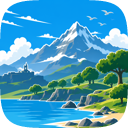
The map. This is the largest content problem in the genre and it is the thing Flockbay is strongest at. Terrain with real relief, a town with sightlines that make sense, a ridge you have to commit to crossing, weather and time of day. You build it by hand, which is the only way a map ends up having places worth fighting over.
The rules. A ring that closes on a schedule and damages anyone outside it. Loot spawn tables with rarity. Inventory and weapon handling. Downed states and reviving. Spectating. The scoreboard and the endgame. All of that is GDScript, and Flockbay writes it into your project.
And the feel. Recoil, movement, the weight of a sprint, the sound of being shot at from somewhere you cannot see. You tune these by playing, which you do from the first session because the game runs locally on the bundled Godot.
A sensible way to actually make progress
Build it single player first, against bots. That is not a downgrade, it is the only version you can iterate on quickly. A ring, a map, twenty AI opponents, and a real question about whether the map is any good.
Almost everything you learn there transfers. If the map is boring with bots, it is boring with people. If the loot curve is wrong, it is wrong either way. The multiplayer question can wait until there is a game worth connecting people to.
That advice is not a workaround. It is how the genre is actually developed.
More on this: A MOBA is mostly balance, and balance is play testing
Why local matters here
Battle royale maps are enormous, and the reason browser-based tools do not produce them is not imagination. It is that a tab cannot render a square kilometre of terrain with a draw distance that lets you plan a route.
Flockbay is a desktop app for Windows with Godot inside it. The map runs on your GPU at your framerate. That is the difference between designing a real map and designing a small arena you are pretending is a map.
Building needs an internet connection because the chat, asset generation and world data come over the network. Playing what you built does not.
The map is where you should spend the time
In this genre the map is the design. Every memorable moment happens because of a specific piece of geography: a building with one way in, a valley you have to cross in the open, a hill that looks safe and is not.
That means the map cannot be generated. A generated landscape produces terrain without intent, and intent is the whole point of a battle royale map. Somebody has to decide that this ridge is worth fighting over, and the deciding is the design work.
Building it by hand is slower than pressing generate and it is also the only version that works. Fortunately it is not slow in absolute terms — sculpting terrain and placing a settlement is an afternoon, and the afternoon is spent on the thing that matters.
A practical approach is to build a quarter of the map properly and play only that. If a quarter is not interesting, four of them will not be either.
Adjacent games that are more achievable
Several games in the neighbourhood get most of the appeal without the live service problem. An extraction shooter against AI. A survival game on the same map with the same loot logic. A single player last-stand mode with a closing ring.
These are not consolation prizes. They use the same map, the same combat and the same loot systems, and they are finishable by one person. If the multiplayer version is ever going to happen, this is also the route to it.
Questions
- Can I make a hundred-player online battle royale?
- Not as a hosted service, because we do not run servers. The game code, including networking, is written into your own Godot project and running it is your responsibility.
- Can I make a single player battle royale with bots?
- Yes, and it is the sensible place to start. The map, ring, loot and combat all work the same way.
- How large can the map be?
- Large. The game runs locally on your machine rather than in a browser, so terrain and draw distance are practical rather than aspirational.
- Does it handle anti-cheat?
- No. That is a live service problem and it is outside what a game maker does.
- What does it cost?
- The download is free and the builder is free to use. Flockbay is free on your own AI: your Claude or ChatGPT plan, your own agent, or an API key.