Making a game from a picture: what a reference image can and cannot do
By Eduardo Orellana · Updated
Flockbay is free on your own Claude or ChatGPT plan. Claude Pro or Max, or ChatGPT Plus or higher, builds a real Godot project in the Godot editor. Claude Free and ChatGPT Free do not run here. More models are optional, a credit reload at API prices. Windows today. The engine is the official Godot release. A picture is the best way to say what a game should look like and the worst way to say what it should do. Flockbay treats it as a reference you build against, not a button that produces a game.
What a picture actually contains
An image carries an enormous amount about mood, palette, scale and light, and almost nothing about rules. Look at a screenshot of a game you love and try to work out from the pixels alone how far the character jumps, what happens when you run out of stamina, or whether the doors need keys. You cannot. That information is not in the picture.
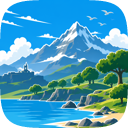
Which is why "upload an image, get a game" is a claim worth being sceptical of. What you can honestly get from an image is a look: the colour of the light, the density of the trees, the silhouette of the buildings, the general sense of what kind of place this is.
That is genuinely useful. It is just not the same thing as a game, and treating it as one is how people end up with a pretty scene and nothing to do in it.
More on this: What generated pixel art is actually good for
Using a reference the way it works
Keep the picture open beside you and build against it. In a 3D world, match the terrain shape first, then the light, then the density of what is on the ground. In a flat one the order is different: the sky colour and the band of scenery along the horizon carry the mood, then the shape of the ground you paint, then what stands on it. Three things either way, and all of them set directly in the builder rather than described.
Assets that need to match the reference can be generated, sourced from the web, brought in from your own files, or built as geometry directly. Which of those makes sense depends on the picture. A stylised low-poly reference is often quickest built directly; a dense photographic one usually is not.
Then stop matching and start playing. The picture got you the atmosphere. From there the reference stops being useful, because a still image has no opinion about what the fifth minute of your game should be.
More on this: AI low poly game maker: a style that a small project can actually finish
Where the rules come from
You describe them and Flockbay writes them as GDScript in your project. This is the half of the game the picture could never have told you, and it is the half where plain language works well, because rules are naturally sentences.
The loop is: say what should happen, play it, say what is wrong. You do not read the code unless you want to. You do judge the result, every time, because you are the only one who knows what the picture meant to you.
More on this: Make a video game with AI: a straight account of how it works
The practical setup
Flockbay is a desktop app for Windows. It installs, it bundles Godot, and your game runs locally on your own machine when you press play.
Building is online. The chat, asset generation and world data come over the network. Playing what you built does not need a connection.
The download is free, and so is building by hand. Flockbay is free on your own AI: your Claude or ChatGPT plan, your own agent, or an API key.
A better way to start than an upload
Pick the one thing in the picture that made you want to make a game. Usually it is not the whole image. It is the light, or a single structure, or the emptiness.
Build that one thing first, badly, and go and stand in it. If the feeling survives being playable in the space you built, you have a game to make. If it does not, you have learned that in an hour instead of a month.
The usual way it fails points at a decision you made before anything else. Some images only hold up from the angle they were painted at, and being able to walk round them is what kills them — which is an argument about which of the two pictures you picked when you created the project rather than an argument against the reference. A composition that dies in three dimensions is often perfectly sound held flat, with the scenery along the horizon doing the work the painting was doing.
Matching a style you did not draw
The two things that carry a visual style are colour and silhouette. Get the palette approximately right and the outlines approximately right and most people will read your scene as belonging to the same family as the reference, even if the details differ completely.
Detail is much less important than it feels. Reference images are usually final art from a finished production, and chasing that level of finish on a first project is how projects stop.
It is also worth checking whether the picture is achievable in motion. A palette travels. A painted effect that only exists because someone rendered one frame by hand does not, and no amount of matching colours will get it. Building a rough version early is how you find out cheaply which of the two you are holding.
Questions
- Can I upload an image and get a playable game?
- No, and no honest tool can. An image describes a look, not rules. Use it as a reference while you build the world and describe the rules to Flockbay.
- Can I use my own photos or concept art?
- Yes, as reference and as source material. It is a normal Godot project, so your own image files work.
- Does it generate art to match a style?
- Asset generation is available, and assets can also come from the web, from your files, or be built directly as geometry. You will be told which route was taken.
- Is this a browser tool?
- No. It is a desktop app for Windows, and your game runs locally on the bundled Godot.
- What does it cost?
- Free download, and the builder is free. Flockbay is free on your own AI: your Claude or ChatGPT plan, your own agent, or an API key.