Island Architect builds its towns out of curves instead of tiles
Most town builders hand you a grid and ask you to fill it in. Island Architect hands you a cliff and a sculpting tool, and the town has to bend around whatever the rock is already doing.
Sculpting a town instead of placing one
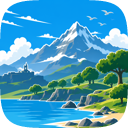
You build seaside towns wedged into cliffs. Streets wind because you drag them that way, cottages sit on ledges because you cut the ledge first, and the harbour is whatever shape you left at the waterline. The reference points are Mediterranean and Baltic coastal architecture, and the pitch is explicitly free-form: no rules, no pressure, no fail state waiting at the end of a timer.
The unusual part is the verb. In a tile builder the only real decision is where — you pick a building from a list and you pick a square, and everything else about the object was decided by someone else months ago. Sculpting moves the decision into the shape itself. A drag has a length, a curve, a thickness and a slope, so two players who place the same tower in the same place still end up with two different towers.
It also cuts the other way, which is rarer. You can dig sea caves, carve tunnels and sculpt arches, so the cliff is material rather than an obstacle to be levelled. Most builders treat terrain as a surface: you flatten it, you pay a cost, you get your grid back. Treating rock as something you remove as well as build on top of is what makes a tunnel under a hill a design idea rather than a texture.
The architectural reference is doing more work than it looks. Hill towns and old harbours look the way they do because building followed the rock and the water instead of a survey line. Whimsical towers and barely-wide-enough alleyways are the natural output of that constraint. Pointing the tool at that tradition means the shapes the game is good at making are also the shapes it wants you to admire.
Why a builder with no rules is hard to design
Analyzing Mario to Master Super Mario Maker is the honest reference for the risk here. Its argument is that a blank canvas stops being intimidating the moment you treat it as an exercise — take apart work you admire, name the patterns you find, then use them. A game whose whole promise is that nothing is required has the blank canvas problem in its purest form. The strongest thing Island Architect does about it is hand you a specific tradition to copy from, rather than a generic empty plot.
The Secret of Mario’s Jump (and other Versatile Verbs) is the one the whole design rests on. The essay argues that a great verb is not a great button — it is one action whose outcome changes wildly with context, timing and speed. Here there is essentially one action: dragging form into and out of rock. It has to produce a staircase, an archway, a tunnel mouth, a sea cave and a harbour wall, depending only on where you did it and how hard. If that verb turns out to have one good use and four awkward ones, no amount of scenery rescues it.
Secrets of Game Feel and Juice explains why the tuning is not a polish task in a game like this. Feel is decided in the second-to-second action, and when there is no score, no failure and no clock, the second-to-second action is all there is. The weight of a drag, whether the geometry snaps or flows, how the camera behaves when you are working inside a cave you just dug — those are the content, not the presentation layer on top of it.
Achievements in a game that advertises no rules
Island Architect is by Björn Ottosson, self-published, listed under Casual and Simulation. It is single-player, with Steam Achievements, Steam Cloud and Family Sharing. It has not been released — the store page says coming soon with the date to be announced, and Windows is the only platform listed so far.
Achievements in a game that advertises no rules is the tension worth watching. They are the one place a free-form builder can quietly grow objectives, and a list of things to tick off is a different game from the tranquil one the store page describes. Done well they are prompts — build something on a cliff, dig through a headland — which is closer to a set of exercises than a checklist.
Ski-E-O! is the other one on this list refusing the grid and letting the land decide. It is a resort tycoon that hands you a real mountain instead of a flat plot, and makes the terrain the puzzle rather than the backdrop.
One game at a time, with the mechanic that makes it interesting.
More indie game postsWant to make your own?
No code, no game engine to learn.