over the hill makes the terrain the opponent instead of the clock
4 min read
A racing game measures you against a clock. over the hill takes the clock away and leaves you with a hill, a 1970s 4x4, a winch, and three friends who are also stuck.
A driving game that refuses to be a racing game
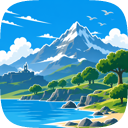
The developers put the thesis at the bottom of their own store page, and it is the design in full: this is a driving game, not a racing game. You take an iconic 4x4 from somewhere between the sixties and the eighties out into valleys, forests, lakesides and mountains modelled on real places, and you go where you decide to go. No grid, no rival, no split time. The thing standing between you and the next ridge is the ridge.
The verbs are unusually physical for the genre. You pick a line through terrain rather than through corners. When the trail runs out you lay planks across the gap. When the truck sits down in mud or hangs itself on a rock you run a winch to a tree and haul yourself off it — or somebody else does, because up to three friends can be out there with you. You load equipment before you leave, and what you chose to bring decides which problems you are able to solve when you meet them.
Around that sits a world worth stopping in: remote cabins, scenic viewpoints, natural landmarks, meteorites that have come down somewhere out there, and portals that open onto new areas. Dynamic weather and a day/night cycle change the ground under you, so the same slope is a different problem in the rain at dusk. There is an in-game camera and a wildlife compendium to fill, which means the game gives you a reason to stop that is not a collectible counter wearing a costume.
There is a shop layer too — merchants and cabins where you spend what you find on upgrades, colours, accessories and cosmetics. Ordinary on paper, except that upgrades here change what terrain you can attempt rather than how quickly you get to the end of it.
Why the route is the content
Following the Little Dotted Line argues that a waypoint trail makes an open world legible and, in the same movement, replaces looking, listening and working out a route with plain obedience. over the hill has to live on the other side of that trade. If the game drew a line to the next cabin, the planks and the winch and the weather would all become obstacles on somebody else’s route, and the interesting decision — which way is even passable — would already have been made for you.
What to build first in an open world makes the point that the instinct is to build the map, when the right first thing is a hundred metres of ground you enjoy crossing. For a game with no finish line that is the entire test. If the truck is not good to drive across an ordinary slope in ordinary weather, no amount of biome variety or wildlife photography rescues it. Funselektor has form here — art of rally was bought largely for how it felt to slide a car, not for what it asked you to do with one.
How Jusant Makes Rock-Climbing More Immersive is the closest structural cousin. Jusant earns its climbing by layering rope length, piton scarcity and route planning onto a simple pair of hands. Planks and a winch are that same idea with an engine attached: a small, finite kit that makes you look at the shape of the ground and ask what crossing it will cost, instead of holding a trigger until the hill is over.
The risk is the one every slow-traversal game runs. Take the clock away and the pressure has to come from somewhere else — the terrain, the weather, the distance back, the three people waiting on your winch. If none of those actually bite, “take your time” quietly becomes “nothing is happening.”
What you actually get
over the hill is made by [Funselektor Labs](https://www.funselektor.com/overthehill) with Strelka Games, published by Funselektor, and coming to Windows. Steam files it under Adventure, Casual, Indie, Racing, Simulation and Sports, which is funny for a game whose own description ends by insisting it is not a racing game — a reminder that store genres are a search problem rather than a design statement.
Single-player and online co-op for up to four, full controller support with a gamepad recommended, and Steam achievements. The co-op is the part worth watching: recovery gear is the rare shared mechanic where helping someone is a physical act performed in the world, with a real chance of making the situation worse before it gets better.
If the appeal is being handed a landscape and no line through it, Open Waters is the sibling on this list. It takes the map away outright and leaves you a compass, a sonar and whatever you can work out yourself. Same bet, different surface: one asks you to read water, this one asks you to read ground.