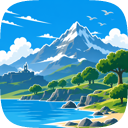
POLYARIS puts an Arctic survival game on skis
5 min read
Most first-person survival games make you walk. POLYARIS straps skis to a stranded polar explorer, hands him a boat, and makes crossing the Arctic the part you have to get good at.
Skis first, then everything else
You are an engineer and polar explorer, somewhere on the border between Norway and Russia when a nuclear explosion goes off far enough away to spare you. Contact with the outside world is gone. So, inexplicably, is everyone else. What is left is you, a pair of skis, a boat, glaciers that are melting, and a stretch of Arctic that has to be crossed before any of the story can be found.
The verbs are the usual survival set with one addition that changes all the others. You eat, drink, dress for the cold, keep yourself dry, craft, fish, loot what other people left behind, and fight polar bears, wolves and scavengers. You also ski. Not as a set piece or a vehicle section — skiing is the movement system, the thing your hands are doing for most of the hours you spend here.
That is a bigger decision than it sounds. Walking is a constant: press forward, arrive eventually, and the ground underneath is scenery. Skis make the ground an input. A slope is speed you did not have to pay for, a climb is a tax, and a route across a valley becomes a question with one good answer and several expensive ones. Terrain stops being the gap between two objectives and becomes the thing you are actually playing.
The boat does the same job on water, and the water is where the systems start biting each other. Being wet in the Arctic is not a status effect you shrug off, so fishing, boating and crossing meltwater all draw on the same account — the warmth you can get back to. A game that tracks warmth, dryness, hunger and thirst as separate numbers has quietly built a machine where any one of them can be spent on another, badly, in a decision that felt reasonable at the time.
Why the crossing is the design
What to build first in an open world argues that the instinct to start with the map is the wrong one, and that the right first thing is a hundred metres of ground you enjoy crossing, because everything else gets stacked on top of it. An Arctic map is, almost by definition, mostly empty. POLYARIS has placed its opening bet exactly where that essay says to place it: if the skiing feels good, the emptiness reads as scale, and if it does not, the same emptiness reads as padding.
The Rise of the Systemic Game covers the other half. Systemic games get their power from environments, objects and rules that can act on each other, producing plans and accidents nobody sat down and authored. A cold meter on its own is a chore. Cold that talks to wet clothing, which talks to dynamic weather, which talks to the day-night cycle, which decides whether a fishing trip was clever or fatal — that is where this genre earns its reputation. The feature list here is more or less a list of the things that would need to be talking to each other.
Why Metro Exodus is so Immersive is the closest thing to a specification for the rest of it: gear you maintain, scavenged upgrades, thin supplies, and a map that is genuinely empty rather than decorated with icons. Looting what other people left behind only lands when the leftovers are scarce and specific enough to remember afterwards. The failure mode of the genre is an inventory full of interchangeable grey resources, and it is a far easier state to arrive at than the good version.
The enemies are the part that could tip either way. Polar bears, wolves and scavengers are three different design problems — an animal you should be avoiding, a pack you should be reading, and people who might not have to be a fight at all. Built as three skins on one health bar, they take more away from the loneliness than they add to the danger.
What you actually get
POLYARIS is made and published by Magic Pie, who are shipping it themselves. It is a single-player game listed for Windows, filed under Action, Adventure, Indie and Simulation, with full controller support and — worth noting in a genre that often treats this as a betrayal — adjustable difficulty, adjustable text size and no timed inputs required. The store says 2026 and nothing firmer.
The stated inspirations are The Long Dark, The Long Drive, The Forest, Sons of the Forest, Sunkenland and DayZ, which is an honest way of telling you the shape of the thing rather than overclaiming a new genre. Underneath the survival layer there is a mystery — what the explosion was, and why there is nobody else — assembled from clues you find while you are out there anyway. That is the right way round: the story is a reason to keep crossing ground, so the ground has to be worth crossing first.
If the appeal is the crossing rather than the campfire, Open Waters is the sibling on this list. It takes the minimap away and asks you to navigate an empty sea with a compass, a sonar and whatever you can work out yourself. Same problem, different blank surface: a large featureless expanse only becomes a game once reading it is a skill.