Mystery is a distance you set
17 min read
By Eduardo Orellana ·
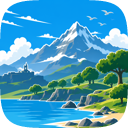
Breath of the Wild, Nintendo, 2017. A dragon crosses the sky and is not explained. Mystery is how long you can stand to withhold the answer.
Explain it and the distance dies
The unknown is a material, like pacing. Breath of the Wild, Nintendo, 2017, proves it early. You leave the Great Plateau, climb a hill at night, and a burning dragon crosses a distance you cannot yet cross. Nobody stops the game to define it. The distance is the effect.
Games that fear the unknown fill it immediately: a codex, a companion, a marker. The fear is that the player will feel abandoned. Sometimes they will. The repair is not to explain everything in the first hour. It is to make the unknown fair. The dragon follows a rule you can eventually learn by watching, not by being told. Mystery that is arbitrary is a tease. Mystery that is a rule you have not been handed yet is a promise. Set the distance on purpose, and do not close it the moment you get nervous.
Treating the unknown as raw material
The unknown is something you can design with, the same way you design with pacing or difficulty. Breath of the Wild proves it within an hour or two of the opening. You come down off the Great Plateau, push out into Hyrule, climb a hill after dark, and a vast burning dragon slides across the sky above you.
Nothing has told you what that is. It could be an enemy, an ally, a scheduled world event, a trick of the light, or a thing the game has no intention of explaining yet. What matters is that your feet start moving. The question arrived first, and the answer is somewhere out there.
Tunic, Outer Wilds, Animal Well, and The Witness are all built on that same sensation: the unknown, the unexplored, the unexplained. They hand you a world that seems to be keeping something from you, and they let you go find out what.
So the design problem is sharper than "hide things." Anyone can hide things. The question is how to withhold information so it reads as curiosity rather than confusion, and how to leave the player feeling that uncovering the truth was their own doing.
Withheld information is where mystery begins
Mystery is manufactured by holding information back on purpose. A designer has plenty to choose from: what waits behind a door, how a system actually resolves, what sits past the horizon line, or what happened here before the player showed up.
Start with the crudest form, the locked door. Tunic is stuffed with them - gates, sealed tombs, enemies you cannot yet beat, edges you cannot yet cross. High on its snowy mountain stands an enormous stone gateway with no handle and no keyhole anywhere on it. It plants two questions in the same instant: what is on the other side, and by what means could this ever open?
The same shape shows up everywhere. Sen's Fortress in Dark Souls. The room of golden statues in Super Metroid. The black egg in Hollow Knight. The Moai head buried in Spelunky's ice caves. None of these are simply obstacles; they are loose ends, and a loose end is a promise that the world is bigger than your current understanding of it.
Context is what makes a locked door stick. A blank sealed wall halfway down a corridor gets forgotten by the next save point. A colossal gate at a mountain summit, a shrine-like chamber that plainly contains something, an object built out of materials nothing else in the world uses - those you carry with you. You walk away, and the question walks with you.
Andrew Shouldice, who designed Tunic, has called these unresolved routes paths into the darkness. The phrase explains the mechanism well. A mystery owes you no explanation up front. It only owes you a visible edge, a blocked route, or an object strange enough to imply that something exists past the present moment.
There is a ceiling on this, though. Every open door you leave behind takes up room in the player's head. Lorelei and the Laser Eyes can tip into overload, because you are ringed by locked doors, safes, boxes, clocks, digits, and symbols all demanding to be held simultaneously. The fascination is genuine; so is the strain of remembering it all.
Animal Well is more disciplined here. Billy Basso has spoken about watching how many loose ends are visible to the player at any one moment. The game will happily show you a door barred from the far side, but it will not drop six interchangeable versions of that door into every room you enter. Sometimes the identical shortcut is built instead as a breakable wall that only reads as a wall from one direction. The mystery survives; the bookkeeping does not arrive before the player is ready for it.
Systems and rules can be hidden as well
The rules themselves are fair game to conceal. Rain World casts you as a soft slug-like animal surviving inside a hostile urban ecosystem. It shows you the essentials - eat, fill your belly, find somewhere to hibernate - and then declines to explain most of what remains.
Withholding that explanation is what makes the place feel genuinely alien. Symbols, gates, creatures, and patterns of behavior arrive with no labels attached. Joar Jakobsson has linked the feeling to his time as a foreign exchange student in South Korea, surrounded by signage and conversation he could not readily parse. Rain World reproduces that stranger-in-a-strange-land state by putting observation before comprehension.
The Souls games work a comparable seam. Stats read as cryptic, items look useless, dialogue resists a first pass, and something as large as world tendency in Demon's Souls can stay opaque for many hours. Starseed Pilgrim opens the same way: one obvious verb, planting seeds that sprout into platforms, and near-total silence about everything else. What do the various seeds do? How do the platforms interact? What are you even trying to achieve?
What makes these games hold is that the rules are discoverable rather than merely absent. You are not being instructed. You are forming a theory, running it, watching it break, and assembling a private model of how this world behaves.
That is a different thing from stripping out the interface or skipping the basics. When a player cannot tell what just happened, why they died, or what actions are even available, the mystery stops being mysterious and turns into static. Experiments need firm ground to stand on. The unknown works best with something dependable sitting right next to it.
And obtuse design runs along a narrow ridge between intriguing and exhausting. Rain World's refusal to explain its fundamentals is inseparable from what it is, but the same refusal sends some players to a guide or out the door. The real work is choosing which parts of the game must be usable and which parts are allowed to stay ambiguous.
Optional skills are the safest place to hide things. Super Metroid never sits you down and teaches wall jumping or bomb jumping, and it never has to, because you can finish without either. It is equally fitting that Rain World makes you learn predator behavior by watching animals. Or that Breath of the Wild expects you not to know what a fantasy ingredient does, or what a mythical dragon in the sky is for.
Intention is the whole thing. Movement, immediate feedback, the core objective, the consequences of routine actions - those should aim squarely at usability. Hidden techniques, unfamiliar creatures, deep systems, optional routes - those can aim at ambiguity. Players extend far more trust to a mystery when they can feel which category they are standing in.
More on this: Why Metro Exodus is immersive: menus become objects
Terrain that asks its own questions
Geography generates mystery on its own. Elden Ring is built out of odd horizons: rot-scarred marshes, castles at impossible scale, buried cities, dead giants, towers in the far distance, caves, ruins, lifts, doors. It seldom tells you what lies over the next ridge. The land does the asking.
It also declines to convert its world into a list of errands. A dense map, a compass, a glowing trail, a checklist - each of these is useful, and each answers a fraction of the question before you have had a chance to feel it. When the interface is forever announcing which things matter, the horizon reads less like a mystery and more like a menu.
What gives a geographic question its force is that the answer is physical. Want to know what is in the cave? Walk in. Want to know what that silhouette on the skyline is? Cross the ground between you and it. The mystery is not a lore entry; it is a heading on a compass.
Zelda has carried this since the beginning - the series grew in part out of Shigeru Miyamoto's memories of wandering the countryside as a child. Riven assembles its mystery from place, language, architecture, and machinery that follows unfamiliar logic. Even its writing and speech feel like part of a world you have to learn how to read.
The balance is fine-grained. A mysterious landscape still should not strand you. Rather than swapping uncertainty for a checklist, a designer can hand players the means to chart the unknown for themselves. Map pins, stamps, screenshots, written notes, hand-drawn maps. Anything that lets someone mark what they saw and where they mean to return.
Silence needs defending too. A talkative companion can flatten wonder just by narrating what you are already looking at. The distance between an eerie unexplained structure and a loudly explained one is enormous. Often the strongest move available is to trust the player to look, to wonder, and to decide for themselves what is worth their time.
That trust reassigns the player's role. They stop being someone following directions through a world that has already been digested for them, and start plotting a route, picking their own questions, and judging which odd shape on the horizon earns the next climb.
Narrative secrets need a reason to chase them
Story is another kind of information to withhold. Outer Wilds opens on a stack of enormous questions. Why does this time loop keep resetting? What became of the civilization that came before? What is the Eye of the Universe? Every planet you visit adds more, from celestial anomalies like the quantum moon down to something as small as an explorer nobody can locate.
The Forgotten City and Her Story are structured completely differently, yet they make the same offer: a significant truth sits at the center of this thing, and you are the one who gets to pull it apart. That turns the entire game into an investigation.
Getting players to care enough to investigate is the difficult half. Outer Wilds did not become compelling because lore was scattered around. Its designers had to get players asking questions unprompted, without simply pointing at the next destination. Genuinely odd sights, arresting events, and moments that land personally are what do it. The Nomai statue in the museum turning to face you works because it is aimed at you specifically. The curator asking what you plan to do out in space works because it converts curiosity into a choice you made.
So a mystery usually needs an ignition source. A quiet clue can be elegant and still be far too quiet to move someone across a solar system. A moon behaving impossibly, a station tearing itself apart, a statue that looks back, a missing person with a trail you can pick up - these give curiosity a handle to grip. The answer stays hidden; the question becomes hard to put down.
It is one principle operating at several scales. A locked door, an unexplained rule, an unmapped landscape, and a narrative enigma all end up doing the same job: putting a question in the player's head. What is behind that? What is that thing? What is that shape out there? What happened in this room?
The result is a curiosity gap - the distance between what the player currently knows and what the game is holding back. That gap can pull someone a long way forward, but only while they believe the answer is worth having and believe there is some route to reaching it.
Players get to supply the answer themselves
Most media resolve a mystery by asking you to keep reading or keep watching until the reveal arrives. Games have a stronger option available: they can make the player the one who closes the gap.
Participation changes who owns the answer. Being handed the solution can still be enjoyable. But if you spotted the clue, held onto the shape of it, tested the rule, guessed wrong, and eventually landed on the right idea, the answer arrives feeling earned. You did not just find out what was hidden - you demonstrated that you understood how the world runs.
Match the method to the mystery. A locked door means hunting for a key. A landscape means crossing it. An obscure rule means watching, experimenting, failing, and going again. Derek Yu of Spelunky has pointed at exactly this pleasure - working things out for yourself, and making your own mistakes on the way. Few other media can offer it.
The mysteries that satisfy most, though, tend to sit past ordinary keys and ordinary walking. They are opened with knowledge. Tunic's mountain door is the clean example: no item unlocks it, no power-up, no upgrade. What you need is to learn a particular way of interacting with the game.
Tunic runs that idea through yellow pads, mechanical totems, stat upgrades, and more. The lock is never sitting in your inventory. It is sitting in your head, waiting for the correct page of the game's retro-style instruction manual to snap it into place.
Outer Wilds treats knowledge identically - a clue found on one planet is what lets you make progress on a completely different one. Riven wants you attending to animal sounds and to a numbering system. Chants of Sennaar makes language itself the key, asking you to untangle words before you can touch its riddles.
Hence the label people reach for: Metroidbrainias. The skeleton is Metroidvania, but the keys are not in Samus's suit or Alucard's item screen. They are in what the player has come to understand.
Why locks made of knowledge land harder
Knowledge keys pay off for a few separate reasons. The first is attention. You cannot trip over one and haul it to the matching lock. You have to read the clue, retain it, write it down, join it to something else, and then apply it on purpose.
The second is that a knowledge gate is, technically, open from the start. Fez invents a language and eventually offers players something like a Rosetta stone for it. Some players cracked it far earlier using pattern analysis and other ingenuity. That produces a story only that player has: they did not merely advance, they outmaneuvered the intended path.
The third is that these gates can be far richer than carrying a code from one room to another. La-Mulana asks you to join inscriptions, calendars, and statues into a single thought. Spelunky asks you to work out how the ankh gets you to an exit most players never see. The payoff is not "I found the key." It is "I worked it out."
That is what separates a good knowledge lock from routine gating. Your character may be completely unchanged - no new blade, no badge, no spell, no upgrade of any kind. You are what changed. You can now do something that was always possible, and that realization makes the world feel deeper than a list of permissions being granted on schedule.
It can even leak past the boundary of a single player's game. Animal Well contains a puzzle that gives each individual player one fragment of a larger mosaic. Solving it requires pooling information across a whole community. The mystery stops being a private deduction and becomes a shared project.
Which forces a decision about how far you expect any given player to get. Fez only requires enough cubes to reach an ending, leaving dozens of anti-cubes, artifacts, and buried secrets entirely optional. Tunic has one ending for players who skip most of the puzzle layer and another for players who chase its most cryptic material. Animal Well describes itself in layers: a playable game for most people, tougher secrets for enthusiasts, and the strangest challenges reserved for those willing to obsess or collaborate.
Layering is what keeps this healthy, because not every mystery should stand between the player and the credits. A game can invite deep investigation without insisting that everyone crack its hardest conundrum. The main line stays readable while the lower layers pay out for whoever keeps tugging at loose threads.
The reveal matters less than the road to it
Sooner or later the mystery pays out something concrete: an upgrade, a shortcut, a bonus area, an alternate ending, a revelation. And when the solving was strong enough, that payout can matter surprisingly little.
Tunic's mountain door is memorable for the process of understanding it. Whatever waits on the far side is worth less than the hunt, the manual pages, the scribbled notes, and the second where the whole thing resolves into sense. The mystery had already finished its job before any reward appeared.
There is one real hazard here. Solving a mystery can teach the player too much about the mysteries still ahead. Elden Ring's catacombs thrill the first time precisely because you do not know what sort of place this is or what is waiting inside. By the fourth or fifth, the pattern is legible: comparable spaces, comparable layout, a boss, a familiar class of reward. Once the answer is predictable before the question is asked, the mystery has already deflated.
None of which bans repetition. Big games generally need patterns to hold together. The failure is when every single thing conforms, and curiosity settles into routine. The defense is to build unique places that refuse the template, or to set a pattern deliberately and then break it.
Super Metroid does the second with its item rooms. It trains you to read them as safe spaces where upgrades are collected. Then one of those upgrades hands you a confrontation you were not braced for. The pattern is still there; you have simply learned never to assume it holds.
The strongest mystery is one you did not know to ask
One last category sits outside the tidy question-and-answer frame. Asking what is behind a door requires knowing the door is there. Some of the most powerful mysteries only start when a player realizes a door has been standing in front of them the entire time.
The Witness puts grid puzzles across a beautiful island. For hours you work panels, learn the visual languages, trace lines through grids. Then, having spent that long seeing the world through those grids, you look down from a mountainside and notice a river bending into exactly the shape of one of those lines. The input you have been using on panels turns out to work on the environment.
That single realization rewrites the game. Paths, flowers, clouds, shadows, and architecture are all candidates now. You have not unlocked a room; you have acquired a new way of looking at the whole island. And the follow-up question is immediate: what else has been sitting in plain view?
Discoveries like that reanimate everything behind you. You start remembering ground you already covered and suspecting it was dense with questions the entire time. The route back becomes as interesting as the route forward, because the game has taught you a new language for reading it.
Dark Souls does a smaller version the first time you hit an ordinary wall and it dissolves. Fez does it when you work out that controller inputs can function as secret codes. Super Mario Bros. does it when a player finds a way out through the interface and past the intended goal. Each one enlarges what you believe the game is capable of containing.
For this to carry any charge, it almost always has to be optional. Jonathan Blow has said the environmental layer of The Witness had to be something a player could credibly finish the game without ever spotting. That is precisely where the charge comes from. Nothing delivered it to you. You took the extra step of noticing.
More on this: Celeste's Assist Mode is a tone of voice
Leave the player holding a question
A game earns a mysterious feeling by concealing any of several things: a door, a rule, a stretch of land, a secret in the story. Each one deposits a question with the player, and each question is a reason to keep going.
What games can do that other forms cannot is let the player answer those questions personally - by exploring, observing, solving, experimenting, and now and then by comparing notes with other people. The answer lands differently because the player had a hand in producing it.
The very best mysteries push past that. Instead of putting a known answer behind an obvious question, they leave something sitting in view, quietly implying there is more here than you have understood. When the player finally sees it, the game expands underneath them. The world is no longer just full of secrets; it is full of questions they had not yet learned how to ask.
You cannot settle any of this on paper. Whether your unexplained thing reads as intriguing or simply broken is something you find out by getting the build running and playing it, and then trusting your own reaction to it.
Build it in Flockbay
In the Flockbay app, put one thing in the distance that you refuse to caption. It must have a behavior a player can notice on a second visit. Play twice. If the second visit teaches nothing, the mystery is empty. Add a behavior, not a paragraph.
An AI open-world game maker and an open-world adventure template will caption the horizon. Delete the caption.